
Coaching, organized.
A workspace built for the practice of professional coaching.
Exantur gives coaches and coaching organizations a single, integrated workspace to manage client relationships, deliver structured coaching programs, document sessions, track goals, run accountability, and engage coachees between sessions through check-ins and a dedicated portal. It also handles the practical side of a practice: online booking, automatic session reminders, calendar sync, and client invoicing. Designed for professional coaching practice, not adapted from a generic project management tool.
EU data residency · GDPR-compliant · Row-level security
Built for professional coaching practices across Europe.
The improvised stack breaks down
Most coaches run their practice across tools that were never built for coaching. It works, until it does not.
- Session notes scattered across documents, impossible to scan before a session.
- Accountability items and goals fall out of view between sessions.
- Coachees have no window into their own progress beyond memory.
- Client history lives in five places at once, and none of them talk to each other.
What Exantur is
Exantur is EU-hosted coaching practice management software for professional coaches and coaching organizations, built for the practice of coaching rather than adapted from a generic CRM.
Coaching is relational work. The conversations between coach and coachee - the careful listening, the precise question, the long pause before something important surfaces - are where change happens. But coaching is also operational work, and the operational dimension is underestimated by almost every tool built for it.
Between coaching conversations, there are program structures to establish and maintain. There are session notes to capture in a form that is retrievable and useful, not buried in a word processor under a client's first name. There are goals to track across weeks and months, accountability commitments to follow up on, check-ins to send, documents to organize, assessments to review, and the accumulated evidence of change to make visible to the coachee who is living through it.
Most professional coaches manage all of this across an improvised collection of tools: a spreadsheet for client contact information and status, a word processor full of session notes organized by date, a chat application for check-ins, a calendar tool for scheduling, and email threads for everything that does not fit anywhere else. This improvised stack works, after a fashion. But it fails in ways that matter: notes become siloed and hard to search, accountability items fall out of view between sessions, the history of a coaching relationship becomes impossible to scan in the minutes before a session begins, and the coachee has no visibility into their own journey beyond what they can reconstruct from memory.
Exantur exists to replace this improvised collection with a single, integrated workspace built specifically for the professional practice of coaching - one where the structure of the tool reflects the structure of the work. That includes the practical layer coaches used to bolt on from separate apps: coachees book their own sessions through a personal or public link, reminders go out automatically, sessions sync both ways with Google Calendar and Outlook, video links are provisioned per session, and invoices - in iDEAL, Bancontact, SEPA, or card - are raised and paid without leaving the workspace. It also covers the tools a solo coach used to string together from a dozen products: e-signed coaching agreements, habit trackers and progress charts, drip-released programs and shared lesson material, a public offer page with lead capture, and an optional directory listing to be found - one workspace instead of a stack.
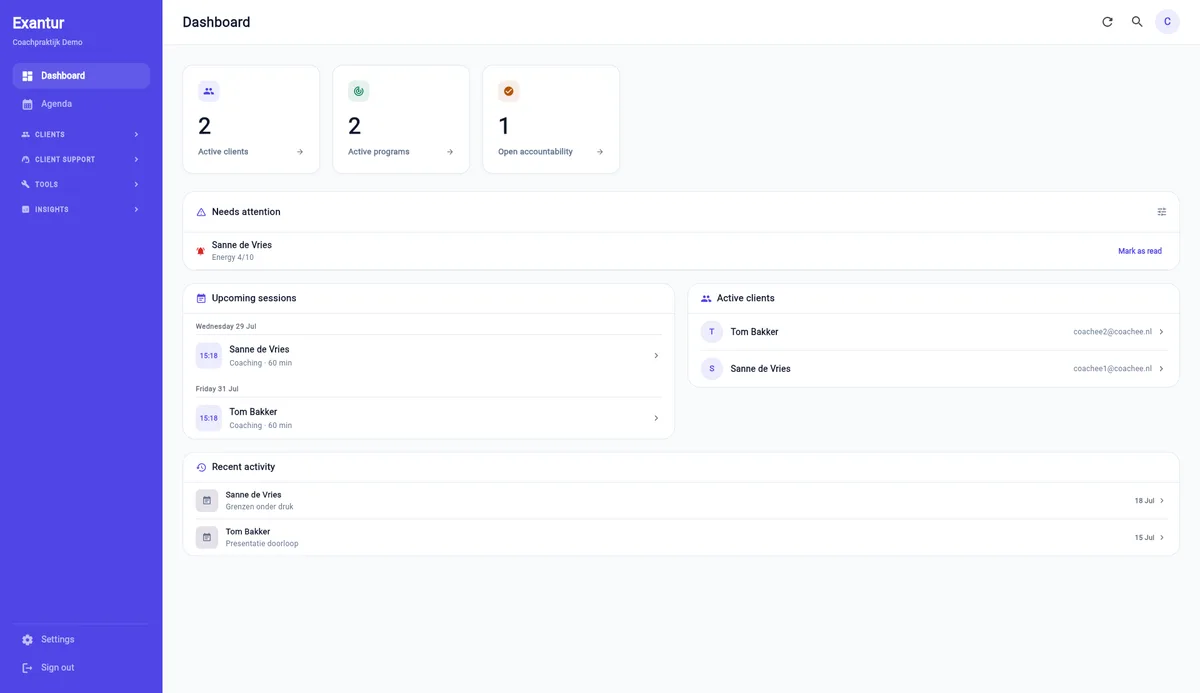
What changes with Exantur
Walk in prepared
The full history of a coaching relationship is one screen away - notes, goals, check-ins, and progress - so every session starts where it matters.
Keep the work alive between sessions
Check-ins, accountability, habit trackers, drip-released material, and a coachee portal keep momentum going in the days that actually shape change, not just the scheduled hour.
Make progress visible
Goals, assessments, and progress charts over time turn a coaching journey into something the coachee can see and the coach can evidence.
Trust built in
EU hosting, GDPR-by-design, and row-level security mean sensitive coaching data is protected without you having to think about it.
How does Exantur work?
From first invite to ongoing practice, the structure of Exantur follows the structure of coaching.
- 1
Set up your workspace
Create your account and your organization is ready. Add your profile and branding in minutes.
- 2
Add coachees and programs
Invite a coachee to their own portal and build a structured program with goals, sessions, and milestones.
- 3
Run the practice
Let coachees book their own sessions, send automatic reminders, document sessions, track accountability, and share documents - all in one place, with your calendar kept in sync.
- 4
Show the change and get paid
Assessments, outcomes, and progress views make the journey visible to the coachee and evidenced for you - and client invoices go out and get paid without leaving Exantur.
How is Exantur different from a generic CRM or course platform?
A generic CRM is built to manage a sales pipeline and a course platform is built to sell content; coaching is bolted on. Exantur is built for the coaching relationship itself: sessions, structured notes, goals, accountability and a client portal in one EU-hosted, GDPR-ready workspace, with booking and invoicing included.
| Exantur | Generic CRM | Course platform | |
|---|---|---|---|
| Built for | The coaching relationship | Sales pipelines | Selling courses |
| Structured session notes | Yes, core | Generic notes/fields | No |
| Goals, accountability & check-ins | Yes, built in | Via custom fields | Limited |
| Client portal | Dedicated coachee portal | Rare | Course dashboard |
| Booking + invoicing | Included (0% fee) | Add-ons | Commerce-first |
| Data residency | EU-hosted, GDPR, DPA | Usually US | Usually US |
Everything your practice needs, in one place
The operational side of coaching, handled - so your attention stays on the conversation.
Client management
Every coaching relationship in Exantur begins with a client record that holds contact information, current status, coach-private notes, the programs the client is enrolled in, an assigned coach within the organization, and a complete history of all the work done together. At a glance, a coach can see which clients are currently active, when each client's last session was, what accountability items are outstanding, and how recently a check-in was submitted. Clients can be searched by name and filtered by status. When a coaching relationship pauses or concludes, the client record persists as a complete account of the engagement - available for review, for handover to another coach, or as a reference if the relationship resumes at a later date.
Programs and sessions
Coaching programs are the primary containers for structured coaching engagements in Exantur. A program holds a name, a description, a start date, a planned end date, and an optional planned session count. Within each program, session records accumulate over time: each recording the date, duration, format or location, and a structured set of notes across observations, insights, breakthroughs, and action points. Free-form session content is also supported. Coach-private notes are stored separately and never exposed through the coachee portal. Over the course of a program, session records build into a complete documentary history of the engagement - searchable, reviewable, and available as context for every session that follows.
Accountability
Accountability is one of the most reliable mechanisms through which coaching produces lasting behavioral change. When a person has stated a commitment clearly, agreed on a timeline, and knows they will account for it in the next session, the probability of follow-through increases substantially. Exantur builds accountability into the coaching relationship as a native feature rather than something managed separately. Accountability items are created for a client, assigned a due date, and given a completion status. They are not attached to a single session - an item created in session two remains visible and tracked in sessions three, four, and five until it is marked complete or explicitly closed.
Check-ins between sessions
The work of coaching does not only happen during sessions. The reflection, the practice, the integration of new perspectives into daily behavior - this happens between sessions, in the ordinary territory of daily life. Check-ins are Exantur's tool for supporting this inter-session work. A check-in is a short, focused reflection that a coachee completes through their portal, responding to questions about their current state, progress on active goals, and other dimensions the coach considers relevant to track continuously. Coaches design the check-in format - using standard question sets or building custom sequences specific to a client's coaching journey.
Goals and progress
Goals in Exantur are attached to a client and can be associated with a specific program. Each goal has a description, an optional target date, a coach-assessed progress rating, and optionally a coachee self-rating - capturing both the coach's professional assessment of progress and the coachee's own experience of it. Goals can be updated as the coaching work develops. The record of how a goal was initially stated, how the coachee's relationship with it changed over time, and what the eventual outcome was forms part of the coaching history and a source of insight into the coachee's development.
Assessments
Exantur includes structured assessment tools that coaches can deploy with coachees as part of their work. These include a DISC-style behavioral profile assessment and a Wheel of Life exercise - two of the most widely used frameworks in professional coaching. Coachees complete assessments through their portal. Results are immediately available to the coach and become part of the coaching record, available as a reference point across the full engagement.
Documents and assignments
Coaches regularly share materials with coachees: frameworks to read, worksheets to complete between sessions, assignment briefs, reflection prompts, and supporting resources. In Exantur, all of these can be uploaded to a client's document library and made available through the coachee portal. Coachees can also upload documents - completed worksheets, written reflections, or materials they want to bring into the coaching conversation. All documents are stored securely, organized by client and program, and accessible throughout the engagement.
Coachee portal
The coachee portal is the part of Exantur that coachees interact with directly. Every coachee receives access to a portal through which they can see their own coaching journey: their active programs, the goals they are working toward and current progress on each, their check-in history, outstanding accountability items, documents and assignments their coach has shared, and their assessment results. The portal is designed to make the coachee an active participant in their coaching journey.
Scheduling and online booking
Coaches define their appointment types and weekly availability once, and coachees book their own sessions from the portal - no back-and-forth email to find a slot. A public booking link lets prospects request an intake session without an account; that request becomes a lead the coach can convert into a client in one step. Every booking lands as a session in the workspace, and availability respects the coach's real calendar so nothing gets double-booked. Booking is available on every plan.
Session reminders and no-shows
Exantur sends automatic session reminders 24 hours and one hour before each appointment - by email to the coachee (when they have reminders enabled) and in-app to the coach - so fewer sessions are missed. When a session does not happen, the coach marks it as a no-show, keeping attendance history accurate for follow-up and reporting. Reminders are available on every plan.
Client invoicing and payments
From the Starter plan up, coaches can invoice clients directly from the workspace. Exantur connects your own Stripe account and raises proper, EU-valid invoices with VAT details, paid by iDEAL, Bancontact, SEPA direct debit, or card. Exantur takes no cut - the platform fee is 0%, you keep the full amount minus Stripe's own processing. Where a client is paid for by an employer or sponsor, the invoice is routed to that payer while the coaching relationship stays with the individual.
Calendar sync (Google and Outlook)
From the Starter plan up, a coach connects Google Calendar or Outlook and sessions sync both ways: sessions created in Exantur appear in the coach's calendar, and external events block those times so coachees can never book over them. Sync is continuous, with a daily reconcile as a safety net; external event details stay private - Exantur only reads busy/free time, never the titles of a coach's personal appointments.
Video links per session (Zoom, Teams, Google Meet)
When a coach connects Zoom, Microsoft Teams, or Google Meet, a meeting link is provisioned automatically for each online session and attached to the booking. The link appears in the coachee portal and in reminders, so nobody hunts for a URL before the call starts. It stays with the session record, and re-scheduling keeps the link in sync.
Progress charts over time
Beyond a single goal rating, Exantur turns a coaching journey into charts that read at a glance. Goal progress, check-in responses, and other tracked dimensions are plotted as time series so both coach and coachee can see the trend, not just the latest number. Wheel of Life results can be compared across dates to show how balance shifts over the course of the work - the accumulated evidence of change, made visible.
Habit trackers and streaks
For change that lives in daily behavior rather than the scheduled session, coaches can set up habit trackers a coachee updates from the portal. Each habit carries its own value type and target, builds a streak as the coachee keeps it up, and reports compliance over time. It turns loose intentions between sessions into something concrete, visible, and easy to follow up on.
Assignable worksheets
Beyond uploading files, coaches can build structured worksheets with a block builder - headings, text, number fields, media, and a signature block - and assign them to a coachee to complete in their portal. Responses come back attached to the coaching record, so intake forms, reflection exercises, and structured assignments live where the rest of the work does instead of in a separate form tool.
Drip programs
A program can release its content on a schedule rather than all at once: materials, assignments, and prompts unlock on relative days from the coachee's start date, with nudges as each step opens. Coaches see how far each coachee has progressed through the sequence, so a self-paced track still gives the coach a clear signal of engagement between sessions.
Share materials and lessons
Coaches can organize supporting materials and short lessons and share them with a coachee as part of a program - readings, exercises, and reference resources that reinforce the work between sessions. It is a supporting layer within the coaching relationship, not a separate content product: everything a coachee opens sits in the same portal as their goals, check-ins, and sessions.
Digital contracts and e-signature
With the Agreements add-on, coaches send a coaching agreement or intake contract for the coachee to sign digitally (eIDAS simple e-signature). The signed document is rendered to a PDF server-side and stored with the coaching record. Booking can be gated on a signed agreement, so a coachee cannot book their first paid session until the contract is in place.
Discount codes and coupons
When a coach invoices clients through Stripe Connect, they can issue discount codes and coupons that apply to a coachee's payment - a percentage or fixed amount off an offer or session. Useful for early-access pricing, referrals, or a returning client, without leaving the workspace or touching Stripe directly.
Offer pages and lead capture
Each program can have a public offer page - a clean page describing the coaching, with paid enrollment handled through Stripe Connect. Prospects who are not ready to buy can leave their details, and every inbound enquiry lands as a lead the coach can follow up on and convert into a client. It gives a solo coach a simple sales page and a lead inbox without a separate marketing tool.
Public coach directory
Coaches can opt in to a public Exantur directory with a profile that goes live after review. Prospective clients can browse and filter by specialism, language, and distance, then request a session or an intake. It is an optional way to be found - listing only, on the coach's terms - not a marketplace that sits between coach and client.
Web push and install (PWA)
Exantur is a progressive web app: coaches and coachees can install it to their home screen and receive web-push notifications - a new booking, a submitted check-in, a session reminder - without a separate native app to download. It brings timely nudges to the device while keeping everything in one web workspace.
AI assistant
With the AI assistant add-on, coaches can draft session summaries, prepare a briefing before a session, and generate an end-of-program report from the coaching record. The coach triggers each action, reviews the output, and decides what to keep - it is a drafting aid, not an autopilot. Only coaching content is sent for processing, never names or contact details, and you can configure your own provider key.
Courses (LMS)
Coaches can build full courses with modules and lessons, add quizzes to check understanding, and issue branded certificates when a coachee completes the course. A course can be delivered inside a coaching program or sold on its own through the coach's own connected Stripe account. Coachees work through it from their portal, so structured learning sits alongside their sessions, goals, and check-ins rather than in a separate tool.
Group sessions
Sessions do not have to be one-to-one. Coaches can run a session with multiple participants, track who attends, and keep shared session notes for the group. This lets cohorts and group programs live in the same workspace as individual coaching, so a coach running both keeps one consistent record instead of splitting the work across separate systems.
Secure messaging
Coach and coachee can message each other in real time inside the app. Quick questions, encouragement, and nudges between sessions stay within the coaching workspace instead of scattering across email and WhatsApp. Because the conversation sits next to the client record, the context of the coaching relationship is always there when a message comes in.
Exercise library
Exantur includes a library of reusable interactive exercises and worksheets that coachees complete from their portal. Coaches can also run an exercise together in a live mode during a session, working through it in real time. Either way, the responses save to the client record, so what a coachee produces stays part of the coaching history rather than disappearing after the exercise is done.
Session templates
Coaches can save a session structure and note layout once and reuse it for future sessions. A recurring session type - an intake, a review, a standard weekly format - starts from a consistent template instead of a blank page. It keeps documentation uniform across clients and saves the coach from rebuilding the same structure every time.
Session packages
Coaches can sell blocks of sessions rather than one at a time - a strippenkaart. A client buys a package, and Exantur tracks how many sessions have been used and how many remain, so both coach and client always know where the balance stands without anyone counting by hand.
Referral program
Coaches can refer other coaches to Exantur and track those referrals and their status from within the workspace. Attribution is handled automatically, so a coach who recommends the platform can see which referrals came through without keeping their own list.
Outcome tracking
Coaches can define the outcome metrics that matter for a given engagement and measure them over time. This turns coaching results into data a coach can actually show - to a client who wants evidence of progress, or to an employer or sponsor paying for the work. Instead of describing impact in general terms, the coach can point to how the chosen measures moved.
Workflow automation
On higher-tier plans, coaches can set up rule-based automations across their practice. A trigger - a new booking, a submitted check-in, a program milestone - fires an action such as sending an email, so routine follow-up runs itself. It removes the small, repetitive admin that otherwise sits between a coach and their actual coaching work.
Client satisfaction (NPS)
Coaches can collect a Net Promoter Score from clients and track satisfaction trends over time. Rather than assuming clients are happy, a coach measures it, sees how sentiment moves across the engagement, and catches a dip early enough to do something about it.
Connected where it counts
Exantur is not a bloated all-in-one suite bolted onto a dozen integrations. It does the coaching work deeply and connects to the few things a practice actually needs: two-way calendar sync with Google Calendar and Outlook, and payments through Stripe (iDEAL, Bancontact, SEPA, and card). Everything else stays in one secure EU workspace - no lock-in, no scattered stack. You can export your data at any time.
Privacy and trust by design
EU data residency
GDPR-compliant
Row-level security
What coaches say
Exantur is in early access with a small group of professional coaches.
Verified testimonials from practising coaches will appear here as our early-access program grows. We publish only real, attributed reviews - no invented quotes. Want to be an early reference? Get in touch.
Frequently asked questions
Is there a free trial?
Yes. Every plan includes a 14-day free trial. You choose your plan and enter a payment method up front; nothing is charged during the trial. Billing starts automatically when the 14 days end, unless you cancel before then.
Is Exantur GDPR-compliant?
Yes. Data is stored in the EU, encrypted in transit and at rest, isolated per organization with row-level security. A DPA is available on request.
Does Exantur handle scheduling and invoicing?
Yes. Coachees book their own sessions through a personal or public link, reminders are sent automatically, and your agenda syncs both ways with Google Calendar and Outlook. From the Starter plan up you can also invoice clients directly - iDEAL, Bancontact, SEPA, or card via Stripe, including employer-paid billing.
Is Exantur a coaching marketplace?
No. It is practice-management software for coaches and coaching organizations, with courses (lessons, quizzes and branded certificates) built into the coaching relationship. It is not a marketplace that sits between coach and client or takes a commission.
Can I use it as a team of coaches?
Yes. Coaching organizations get multi-coach management with organization-level data isolation and roles.
Can I export my data?
Yes, at any time from within the app. Your coaching data stays yours.
Simple, transparent pricing
Plans for individual coaches and coaching organizations. Every plan includes a 14-day free trial.
Request a demo
See the actual application in a live demo. No sales pressure, no obligation.